Tuesday, 20 June 2017

Groot

This is our new car affectionately named Groot. Students were tasked with producing a new concept car after our Newquay qualifier in 2016. There was a lot of debate around a wheels in versus a wheels out design; in the end we decided to compromise on the above design with the front wheels enclosed and rear wheels exposed. This design allowed us to have the motor in the air flow to help further cool it and improve efficiency. We are hopeful that this will compensate for the additional rear drag. The other advantage of this design is that we have been able to keep the tear drop shape throughout and reduce materials and therefore weight.

After the overall concept was finalised we started to see how we could use bike parts to make the car as they are very sturdy and lightweight. We mocked up various prototypes with timber and bike parts until we were happy then I produced a Solidworks drawing of the chassis for the students.  Students were then tasked with drawing up the wheels and body shapes on Solidworks. We ran a couple of the body shapes through the fluid flow software and identified the best body shape. Students were the tasked with finding a software package that turned a 3D model in to a net as drawing the whole body in sheet metal would have taken a very long time. The students eventually found a couple of programs that would work. The one we eventually used was Pepakura as it was very easy to use.

The net was then saved as a DXF and split up so it could fit on our in house laser cutter. It was the glued together and taped and glassed internally by the students at lunch time and after school.

The students have worked tirelessly on this car for nearly a year. Some of the students have demonstrated determination and resolve well beyond their years. We look forward to the 2017 season and hope to improve on our prior performance.

I would like to thank former students (A level and undergraduate) for their continued support towards the team.

More detail to follow ..........


Monday, 21 September 2015

Aerodynamics - Summer break 2015

During the 2015 summer break Mr Erents and a hand full of students from the Penair Engineering team gave up the torrential rain and the busy Cornish coast to improve the aerodynamics of Raptor Fusion. The challenge was to complete the body on a very tight budget as due to race commitments we only had £150 to spend on the bodywork. After much discussion the team decided to produce a foam core fiberglass body as this would be very light and stiff and could be cut and adapted later if required.


Fiberglass is not an environmentally friendly material however it has properties that other materials struggle to match. The fiberglass body is also likely to last many years and can easily be repaired, so it may actually be better than a body made out of an eco-friendly material that has to be remade multiple times.


When working with fiberglass it is important to have the correct PPE gear. Respirators and good ventilation are a must.


In order to keep costs down we had to use the old body as a mould. The correct way to do this would have been to make a mould from foam however the cost of the foam alone would have exceeded our budget. We would have then had to have the mould cut out using a CNC machine to get the high quality finish we were looking for.


The first thing we did was adapt and pack out the previous body with foam to get the aerodynamic improvements we were looking for. This included shrinking the nose an adding a tail to the car. The tail is very important as the current tail is flat and causes a lot of drag. We also removed 'pinch' points in the wheel arches and raised the front to allow air to flow over the driver. Once the amendments were completed we shrink wrapped the car so that we could remove the body when complete.


Foam panels were then added to the car to stiffen it up before another layer of fiberglass was added.
The new car body is still under development but we will release pictures when it is finally completed. We hope to be able to test the new body at Castle Coombe. We have also made some other modifications that we hope will improve performance.

To be continued......

Thursday, 26 February 2015

Truro College Visit - Flemings left Hand Rule.

On Thursday the 26th of February two A' level physics students from Truro college (Lucy Talbot and Claude De-Rijke-Thomas) delivered a talk to the Penair Engineering club. Students were taught about 'Flemings left hand rule' and were shown, through diagrams and models, how motors work. The students were then tasked to construct their own motor.

The students all really enjoyed this session and would like to publicly thank Lucy, Claude and Paul for setting up and delivering this presentation.


Monday, 9 February 2015

Penair Engineering -  CUC visit

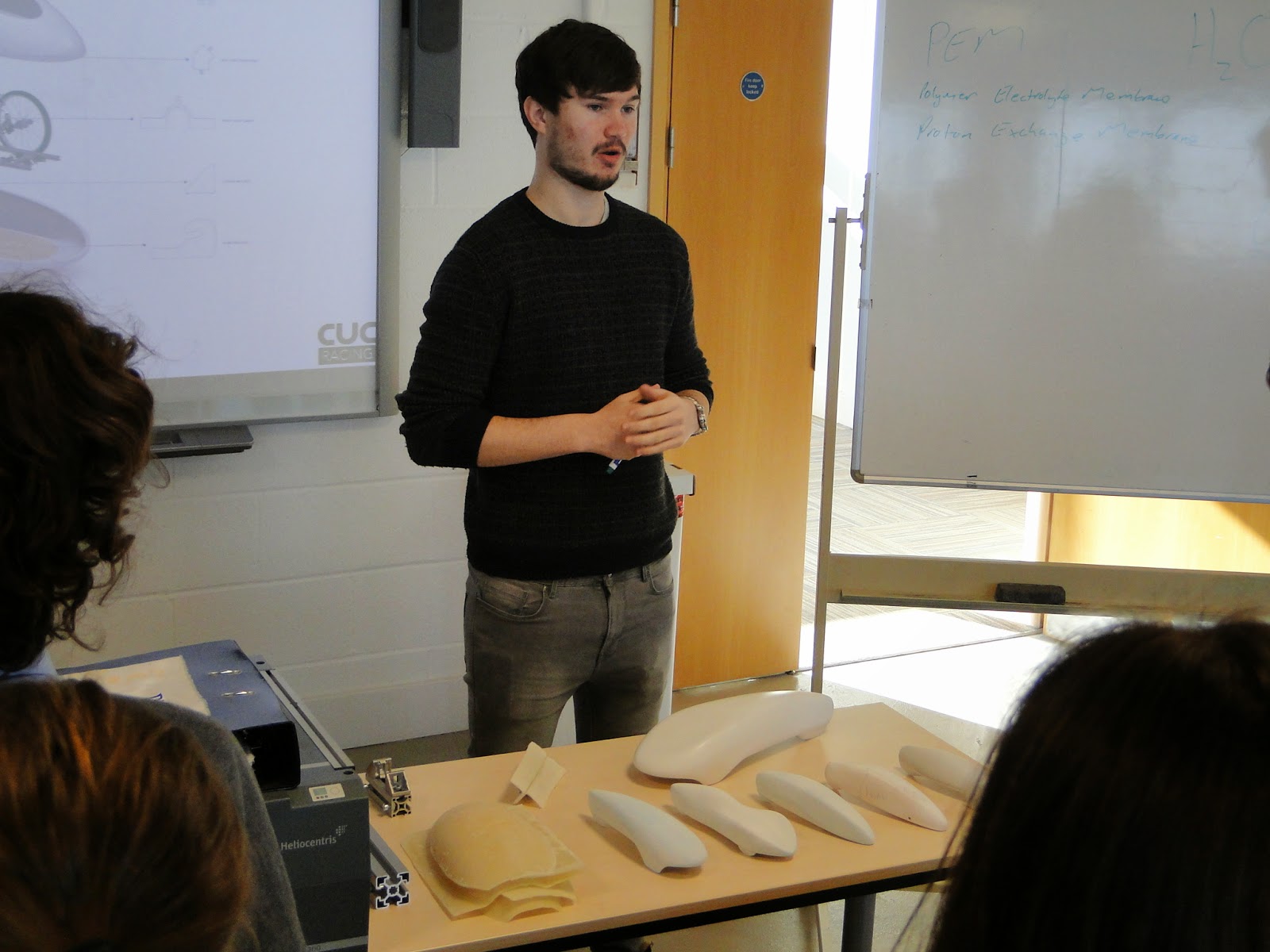
On the 9th of February 2015 Penair Engineering club and some of the science leaders group visited the Exeter university Penryn campus. The group met the team that entered the shell eco marathon with their hydrogen fuel cell car. They explained to us the features of their car and how the hydrogen and oxygen was split to store power that would be then used to power the motor. This inspired us to upload to the blog.


This is the chassis system devised to assemble and disassemble with
 no welding.


This is a model showing the miniature hydrogen fuel cells. the water is separated by the electricity from the solar cells, the motor is then connected to the fuel cell which has stored the hydrogen to make electricity.
 

Monday, 23 June 2014


Green Power

South West Regional Qualifier


Raptor Fusion – ready for practice.


Rock on Raptor and the ladies in pink.


On Thursday the 19th of June Penair School participated in the Greenpower electric vehicle race at Newquay airport.  The event included twenty one other schools from across the South West. All of the teams were battling it out for one of the top three positions,  that would secure them a place in the national final at Goodwood. The weather was stunning, which made for a fantastic atmosphere and made up for the last few years, where the race took place in driving rain.

The Penair Engineering teams had tested their cars on the schools all weather pitch and on the clubs rolling road. This meant that the teams had a clear strategy, and were ready for the new racing format that included making the cars run for longer on a single set of batteries. The practice laps were as eventful as ever for the teams, and highlighted a slight problem with one of our breaks. This was quickly fixed and the car got back on the track to let some of the younger drivers to become accustomed to the circuit. After the problems during the practice the first race went very smoothly with the Penair Engineerings boys’ team leading from the front for the majority of the race. The drivers and pit crew were extremely disciplined and focused on the race strategy throughout. This clearly worked in our favour and allowed us to achieve first place, and gave us a guaranteed position in National Final. The girls team (Rock on Raptor) were not quite as elated. This was due to their car running out of battery power ten minutes before the end of the race, but despite this, excellent driving allowed them to gain a very respectable 8th place.

The second race also started very well with Raptor Fusion again producing some very consistent lap times thanks to some excellent driving from Alfie Spouse and Rufus Leather. The girls’ team were also doing extremely well, but without managing to change the gearing on their car we knew that they may run out of power before the end of the race again. Our suspicions were confirmed five minutes before the finish, but the girls’ had managed to gain a couple of places to achieve a 6th position in the second race. Prior to this however the boys’ team was pulled in due to a break problem and a flat tyre. The team fixed the tyre as quickly as possible but were not quick enough to retain the number one slot. They did however manage to achieve third position in this race due to a flying last lap by Frederick Freeborn. The team also gained the award for best Engineered car and they also gained the Spirit of Greenpower award, for the help they have given to other teams locally. All in all it was an excellent day for both our teams and it was clear many of the other schools involved also thoroughly enjoyed themselves. I would like to personally thank Vaughan Curnow and Jeremy Way and the Greepower team for organising such an excellent event that clearly inspires the younger generations. I would also like to thank Spencer Hosen and Ron Koning for the support they have given to the Penair Engineering club over the past few years.


Tuesday, 15 October 2013


Greenpower National Finals
 
Headline Results, - Raptor fusion 9th place
Rock on Raptor 31st out of 75 competitors in the national final

The Penair Engineering team car Raptor Fusion was fourth on the grid at the National finals joined by 75 other competitors who had either made the mileage or who had been given a wild card. Penair Engineering was also joined thrree other Cornish teams in the final, by Richard Lander, Falmouth and Penryn. We thought our journey from Cornwall was long but other competitors had travelled from the top of Scotland, Poland and even the US. The weather for the final was not as great as last year so the drivers had to be even more focused during the race. The mornings practice had many competitors sliding all over the place with two cars sliding off the track entirely. Both the raptor fusion team and the girls Rock on Raptor team were really focused and driving exceptionally well. The boys team Raptor Fusion remained in the top 5 for most of the race but a missed pit stop and blown fuse meant that we were out of the running for a podium position. The target now was to try and remain the best team in Cornwall. After some nail biting overtaking and some excellent driving from Duncan Covey we managed to finish in 9th place on the day as the top Cornish school. This was a disappointing result as last year we finished in 4th place but we all learned what could be improved next year and will be doing all we can to gain one of the top three slots.

The girls Team Rock on Raptor under the leadership of Debbie Killingback and Ron Koning were the real success of the day climbing 33 places and becoming the most improved team of 2013.

Well done girls!

All of the students are clearly insired by engineering which is at the end of the day what this competition is all about. Previous students from the club have gone on to study Engineering or related subjects at college and one of our previous students George Sowerby has his eyes set on studying Electrical Engineering at university.

Thank you to all of our sponsors who have made this possible. We will be improving the cars over the winter period and will continue to share our successes with you in the future.


Raptor Fusion - ready to race.
 

 Raptor Fusion and a focused team in the pits
 
 
Rock on Raptor - ready to roll

 
You could not miss the girls team. They stood out a mile
and were interviewed by the press on a couple of occassions.


Monday, 8 July 2013

Penair Engineering High Altitude Balloon Project


One year ago we began to look into the possibility of high altitude photography. It seemed that the most feasible method was to use a weather balloon filled with helium as it is safe and relatively inexpensive. After some research we created a prototype which we tethered above Newquay Airport to film the Greenpower race from a bird’s eye view. This was extremely effective and we got some fantastic photos.

Our next issue was that the helium balloon can travel long distances due to high winds at altitude which meant we needed a reliable method of retrieving our payload once it had landed. With little experience in this field, a GPS tracker which used a mobile phone signal seemed the way to go. We therefore picked up two cheap devices for testing.

Another hurdle was that we needed a sturdy and high quality camera to make the journey without being damaged by the extreme cold and lack of pressure. A GoPro seemed the obvious answer and our teacher was willing to donate his old one however the limited battery life was a problem. We therefore hardwired an auxiliary battery supply to ensure we didn’t lose any valuable footage.


A further problem was the weight of our payload, which we needed to keep as light as possible. We bought a polystyrene transport box, packed it with solid roof insulation and cut out sections to fit the camera, GPS unit and batteries. We didn’t want to take the risk of our GPS and batteries freezing as they ascended and the temperature fell to about -55 degrees. So we packed two handwarmers around them before positioning them right in the centre of the box.


The amount of helium was also critical, as we needed to lift the payload at 5 metres per second to get enough altitude before the low pressure expanded the balloon so much that it burst. This meant calculating quite precisely how much weight the balloon had to lift before we attached the payload and let it go. There is a lot of information on the UK HAS website http://ukhas.org.uk/  including a spreadsheet that calculates this for you.

We had obtained approval from the CAA (Civil Aviation Authority) to launch in a three day window from Colliford Lake on Bodmin Moor between 7.00 am and 2pm as we were flying over airspace used by Bodmin, Plymouth and Exeter airports. After a very early start we finally launched at 7.40am into the fog, having run a landing prediction program http://habhub.org/predict/  that showed we should land in the Sidmouth area in about 2 hours. We were very anxious as there was quite a strong westerly wind and we were predicted to fly very close to the sea.


Unfortunately we lost contact with the GPS after only 10 minutes but optimistically drove towards our planned landing area. Two hours came and went and we were starting to think that it might not appear. We had decided to head to the beach to wait for an hour or so but then to our delight we received a text at 10.10 telling us that the GPS was alive and our plans were still on. When we looked up the latitude and longitude we discovered that not only had the balloon stayed up longer than predicted but it had drifted much further. We eventually drove to Piddletrenthide in Dorset and after one false start found it in a maize field just up the road in Alton Pancras. It looked on first inspection as though the camera had taken pictures but until we retrieved the SD card we would not know what they were. So we headed back to the Piddle Inn in Piddletrenthide where Joanna the Landlady was astonished to find that we had driven all the way from Truro.

We were astonished when we started looking at the photos. Not only were there pictures but they were far better than we had ever hoped. We had taken 1 photo every 5 seconds so could reasonably accurately time the flight and could see from the photos that the balloon had burst approximately two hours into the flight. But the big question was how high had it gone? We have no way of knowing exactly but we could see that the camera case had frozen up due to the low temperatures between 10 and 20 km high but amazingly had then cleared again to take our most stunning pictures. So it must have gone into the stratosphere and by analysing the distance it travelled we think it may have gone as high as 36km or nearly 120,000 ft.


It was a long drive home but we were elated. We had taken pictures that showed the blackness of space, the blue strip of the atmosphere and the curvature of the earth. We had achieved with a team of 15 year olds and some cheap and cheerful equipment what only a handful of schools worldwide have managed to do.

We tweeted the picture to Karen Nyberg, one of the astronauts on the International Space Station, who replied that it was an amazing achievement.


Project team:

Orion Page, Woody Polglase, Tim Powell, Dan Kerrison Stock – students

Martin Erents, Louise Allen – staff

With thanks to Nick Cartmill and Tom Allen

Thursday, 27 June 2013

Rock on Raptor


Thursday 20th June 2013

We set off from Penair at five past seven, bleary eyed (well, the boys were anyway) but rearing to go.

After arriving at Newquay airport, we were given wrist bands and sent to set up.

Once we had set up we took our cars over to get scrutinized (checked to make sure they were safe and track legal) then given an hour to practise around the circuit.

Needless to say, we didn’t get off to the best start; Raptor Fusion had to be rescued twice in just that hour and Rocket Raptor was towed back to us once. Fortunately, the problems were fixed and we were up and running again for the race.

Unfortunately, two hours in and Rocket Raptor found itself on the rescue truck headed back to the pit lane. After changing the batteries, Rocket was sent out again with a new driver ready to go. Rocket Raptor made it to the first corner before having to be rescued by the truck for the third time that day. Houston, we have a problem!

After a thorough inspection, the problem was unroofed and after 20 minutes, Rocket Raptor was back on track.

Last time we buy anything from China!

However, luck was not on our side because as soon as Rocket Raptor got back out on track it started to rain. And rain. And rain.

Never-the-less, completely drenched and voices hoarse from cheering (anyone and everyone), both cars pulled into great finishing places, Raptor fusion in second (Lander in first) and Rocket Raptor in eleventh (not bad for a first race, considering the conditions and the breakdown).

I think I speak both the boys and the Pink Ladies (the girls team) when I say we all had a brilliant time and would like to thank everyone who made the day possible.

Thank you!


Tuesday, 23 October 2012


                                     The Final - Goodwood

The Beaulieu motor museum acted as an inspirational stop off on the way up to the national final. All of the pupils clearly enjoyed themselves and were fascinated by the history of motoring.


The morning of the final started with a cooked breakfast in our youth hostel which set the pupils up for the day. It was a cold fresh morning and the weather looked like it was going to be on our side. An hour later we arrived at the famous Goodwood race track and it was clear that the competition continues to grow year on year. The paddocks were full of  hopeful teams and Greenpower had brought in a large LED screen to broadcast the event to the thousands of competitors and spectators that lined the track. The practice session went vey well and it looked like our cars were ready for the final. All the teams worked well together and were a true credit to themselves and Penair school.

The grid looked amazing at the start of the final. The teams all basked in the glorious autumn sunshine and vibrant colours of the 75 cars contrasted with the lush green grass that lay trackside. Whilst the Greenpower team sorted out the final preparations the teams were interviewed in front of the numerous spectators. Whilst not all of the final teams were interviewed, all of our teams were. I am sure the students must have been very nervous about this but it did not come across when they spoke. Final preparations over the final got underway to a huge cheer from the spectators. All of cars started fine and continued to run well for the first half of the race. Blue raptor and Eco raptor were slipping down the field though. It was now we wished we had changed the gearing on Eco - Raptor. The team had decided against it because it was never a real contender due its large frontal area (and parachute at the back) so it was decided that if it is working that we shouldn’t be changed and would be used to test our new technology. The Blue raptor team could change their gearing and advised their driver to go faster. This was unfortunately too much for the old motor and caused the team to retire before the end of the race. The Eco raptor did finish the race but a poor pit stop call caused it to finish much further down the pack than it should have. Raptor Fusion our flagship car continued to go well for the entire final and ended up coming fourth overall. The team were disappointed not to get on the podium but are happy with the result considering it was the cars first season.

The eco-raptor was also recognised nationally for it's innovative technology and achieved the Siemens innovation award. The team are delighted that all their hard work paid off and look forward to developing the technology for next season.

Penair Engineering would like to thank all of their sponsors for their support. Sponsorship has undoubtedly helped keep the Penair engineering team running.


                                                    Raptor Fusion flying past its rivals.

                                     The Eco-Raptor team with the Siemens innovation award.


Friday, 5 October 2012


CASTLE COOMBE


The Raptor Fusion team was the only team from Penair to race at Castle Coombe due to a limited number of spaces available. The team started the race very well but disaster struck when a battery terminal snapped off (that's motor racing!). The car took a long time to recover and the team was consequently off the track for 30mins. This may have been a blessing in disguise though as the team got to really test their car and it's capabilities. The team also learnt a lot more about their batteries! The team was in 38th place when they managed to get back on to the track but some good battery management and excellent driving meant that the team finished in fourth place overall. This was an excellent achievement and the team is going in to the final full of confidence.


                                   Team  - Raptor Fusion


GOODWOOD HERE WE COME!
BUDDING Engineers from Penair School in Truro will be taking part in the Green Power Racing Car National Final at Goodwood in October this year, after successfully qualifying at RNAS Merryfield on Saturday.
With support from Western Power Distribution, the team hope to enter all three of the cars they have built from scratch.  The cars are powered with six 12 volt batteries which are quite costly to maintain and replace.
Graham Whipp a Planner based in WPD’s Bodmin office suggested the school contact the company seeking support to purchase some batteries.  Graham’s step-son Tom, an active member of the Engineering Team, helped design and build the cars.
Graham explains: “WPD is keen to support schools with engineering based projects so explained this to the school who were delighted with the £300 donation to purchase some new batteries.
The students gain a great deal from participating and spend a lot of their own time working on fine tuning the cars and travelling over the country to participate in events.  They are all very committed and I hope their efforts are rewarded with a good placing at the Goodwood event.”
The Green Power IET Formula 24 Race is aimed at students between 11 and 16 years.  Teams have to compete in at least one regional heat and finish in the top three to automatically qualify for the national final.
The remaining 75 cars on the grid consist of those cars that have completed the most miles in any one race with 3 wild cards thrown in for good measure. 

Penair Students before their successful qualifier at RNAS Merryfield in Somerset on Saturday 15th September. 

Graham Whipp from WPD with step-son Tom who took part in the event.

Tuesday, 26 June 2012

Newquay Race 21 June 2012


Newquay south-west qualification race.


On Thursday 21st of June I was part of the engineering club from Penair School that travelled to Newquay Airport to compete in the south-west Greenpower electric car regional race. Our aim was to qualify for the National final at Goodwood in October.  We turned up in perfect racing weather (not too cold or not too hot) but, being Cornwall, that didn’t last very long and soon after it started raining.  Despite this we rolled our three cars up and waited for the scrutineering team to test them.  We didn’t have to wait long before our cars were scrutineered and all three passed the tests fine.  Our new car, built entirely out of wood apart from the electronics, had up-to-date technology installed such as a speed controller and a tablet screen that told you if you were going too fast or too slow.  Although it was the first time the car had raced the team and I had high hopes for our car.


The engineering club had built three cars so consequently we had to split into three teams.  The three cars were called Raptor Fusion, Blue Raptor and Eco Raptor so they were also the names for the three teams.  The teams were each assigned a different colour; red for Raptor Fusion, blue for Blue Raptor and green for Eco Raptor.  We decided that because in the heat of the race people could get mixed up we would give each team hats the colour of their team.  So because I was driving for Blue Raptor I got a blue hat.


Once we had been scrutineered our first drivers got in the car and drove a couple of practice laps.  The other drivers would then have a couple of practice laps in race order.  Because of a shortage of batteries Eco Raptor and Blue Raptor had to share batteries in the practice laps, this meant that the drivers didn’t get as much practice time as they wanted.  But it wasn’t just shortage of batteries that cut down the amount of time drivers got in practicing, well not in Eco Raptor at least.  On the second lap the treacherous surface of Newquay took its toll on Eco Raptor.  The Airway had rough sections in it and some potholes and it was one of these potholes that spelled the end of Eco Raptor’s practice session.  The car did not approve of the two inch hole it went into at over 18 mph and was pulled off the track by Greenpower officials.  After examining the car the team drew the conclusion that the floor beneath the batteries had given way and had caused the batteries to be pulled out.  After 40 minutes of furious work the team, with the help of Mr.Erents, Ron and other adults that are included in the club, managed to get the car onto the grid to race albeit in 21st and last place.  The starting order on the grid for the Penair cars was: Raptor Fusion in 18th, Blue Raptor in 19th and Eco Raptor in 21st.  Not the best starting points for one of the first teams to arrive.


The cars were sent to go row by row and it was clearly apparent that there was something wrong with Blue Raptor when it pushed off and sure enough minutes later it was pulled into the pits by the Greenpower officials.  Not knowing quite what the problem was but knowing that it was something to do with the electronics , the team pulled off the cover off the bottom of the car and tried to find the problem.  Within ten minutes we had, with the help of Ron and Jason, discovered that it was a problem with the circuit-breaker.  In a further 5 minutes we had found a loose bolt connected to part of the circuit-breaker.  Quickly we tightened the bolt and tested the car and we were ecstatic to find that the car was fixed and able to run in the race again.  By this point we had dropped all positions and were in last place but we were just happy to see the car rolling fine back in the race and already making a mark on the Greenpower race, gaining on the opposition quickly and getting back the laps we had lost.  We were back in business.        


Raptor Fusion didn’t encounter a problem as it shot round the 0.74 mile track in less than 2 minutes, the fastest lap time being 1 minute 49 seconds.  It was not long, though, before Eco Raptor came in with a problem in the electronics.  Keeping their cool the Eco Raptor team sorted the problem quickly although the stop cost them positions and they dropped back near the bottom.  At the time it looked like Richard Lander team were going to win but we wouldn’t have that.  Raptor Fusion was running top 5 within the first 1 hour 20 and then it had a problem as well!  This wasn’t as serious as the problems on the other cars but was a problem with the positioning of the wiring.  But the team soon had the wire replaced and the car entered the race again in 4th place. 


As is well known the Greenpower race is all about endurance and to last the full 4 hours you need to have good battery management.  We had a small problem with battery organisation but other than that the cars didn't encounter any more serious problems. 


Penair school had started with all three cars in the bottom 4 but they finished in these positions; Raptor Fusion in 1st!, Blue Raptor in 5th!, Eco Raptor in 12th!  Richard Lander had started looking like they were going to win but part way through the race they had problems.  This was the start of a downward spiral for them and they finished in 6th place.  Your position is judged on how many miles you’ve covered and only 5 cars lasted to cross the finish line.  I’m happy to say that all three of the Penair cars crossed the line.


The awards ceremony announced Raptor Fusion as the winner of the Greenpower south-west regional race and therefore qualifiers for the national Greenpower race at Goodwood.  Our work on Eco Raptor was recognised by the judges who awarded it the Engineering innovation award.  With medals around our necks and smiles on our faces we returned home and looked forward to the challenge of upcoming races.


Despite the award Eco Raptor did not qualify so it and Blue Raptor will both be going up to Somerset to try to qualify in another race.  Raptor Fusion will also be attending the Somerset race as the position you get on the grid in the national Formula 24 race depends on how any miles you’ve covered in previous races.  So Fusion will be racing to gain miles and therefore positions in the Goodwood race. 


I hope Penair Engineering do well in the Somerset race and I will keep you up to date in future races. 
Written by,
 Josh Fann    

Thursday, 24 May 2012

On Saturday 28th April the Engineering team took a mini-bus trip to the legendary race track Silverstone. We stayed in Oxford for a day in a nice Youth Hostel. Unfortunatley the weather was miserable but the team stuck to it and we raced our new car Raptor Fusion on the sunday morning.


When we arrived at the track the team were awestruck at the fact that we were about to race on a track many F1 legends had also raced on. The first few minutes were dedicated to making the car waterproof by covering the carbon fibre chassis. Once that was finished we sent our first driver for the practice laps, Josh. The drivers on the practice laps had to test the car andtell the actual drivers were to brake, where the best racing line was and how the car preformed in the wet. They were also told to drivea "flying lap" to see how fast the car could really go. Our fastest lap time was 3 minutes 37 seconds and that ws set by our driver tom. that particular lap was faster then last year's national champions Rotary Racer.

After the practice laps there was a team a team breifing for the drivers and pit crew.the breifing was short but very to the point. It was to warn all the drivers that if they started to feel too cold they had to pit as 5 drivers had to leave with hypothermia. they then went on to tell us that sme people had strayed onto the international silverstone track, they said that we were to keep off the international track because there was an F4 race on at the same time and " it could get messy". as to prove his point an engine could be heard revving.  

as the first driver prepared to leave there was a final word of warning from one of the adults, chris." many of the cars out on the track have protruding wheels.as today there is a strong cross breeze it could mean that cars could spin out of control, so keep your distance from all the cars!" the first driver set off and performed brilliantly, lapping Richard Lander's can in under 5 laps. At the end of his stint we were running around 3rd and the next driver set off. unfortunatelyour new telemetry system failed to give us the voltage of the batteries and so we had to read it manually.  our drivers continued a stunning performance and we finished the race in 2nd with richard lander 3 places behind in 5th.

we decided that we should stay for the awards ceremony and waited until 2 0'clock to receive our cups and medals. the winnig team was a collage and we were rather impressed with our performance.Giddy with joy we got into the mini-bus and travelled home to our beds after an exhausting weekend.

written by, Josh Fann.   

Monday, 21 May 2012


Penair’s ‘Blue Raptor’ wins the Greenpower Challenge

Penair School’s ‘Blue Raptor’, has outpaced 13 cars from across the South West to win the regional Formula 24 Green Power Car Challenge- a competition for school students to design, build and race electric cars. This is not the first time Penair’s car has won the regional heat. Last year, they won with their previous kit car- ‘White Stripes’.

The engineering team, led by Martin Erents, Chris Parker and Spencer Hosen is thrilled to be going to Goodwood.  The pupils have spent many hours after school designing, building and testing these cars. These pupils are the designers and engineers of the future and to see the cars not only running really well- but winning- is a fantastic achievement.   The team is now sponsored by Inspired Cycle Engineers, who have helped the kids to understand the importance of weight and aerodynamics in vehicle design. 'Blue Raptor' also won the title of the best engineered car and will now travel to Goodwood in October to compete against cars from across the country in the National Green Power Championship.